In short
A solar installation turns sunlight into electricity for your home or business, and uses the CFE grid as a backup. What you don't use at the moment goes to the grid, and what you're short of, for example at night, comes from the grid.
As for timing, installing the panels is usually the fastest part: days, not weeks. What drags out the project is the quote and the CFE paperwork. One installer reports 6 to 10 weeks in total for a business; a home, being simpler, usually lands closer to the low end, although there's no official timeframe.
Source: Niko (installer): stages and timing of a business installation; commercial reference, not an official timeframe ↗The parts and what each one does
These are the parts your quote should itemize.
| Part | What it does |
|---|---|
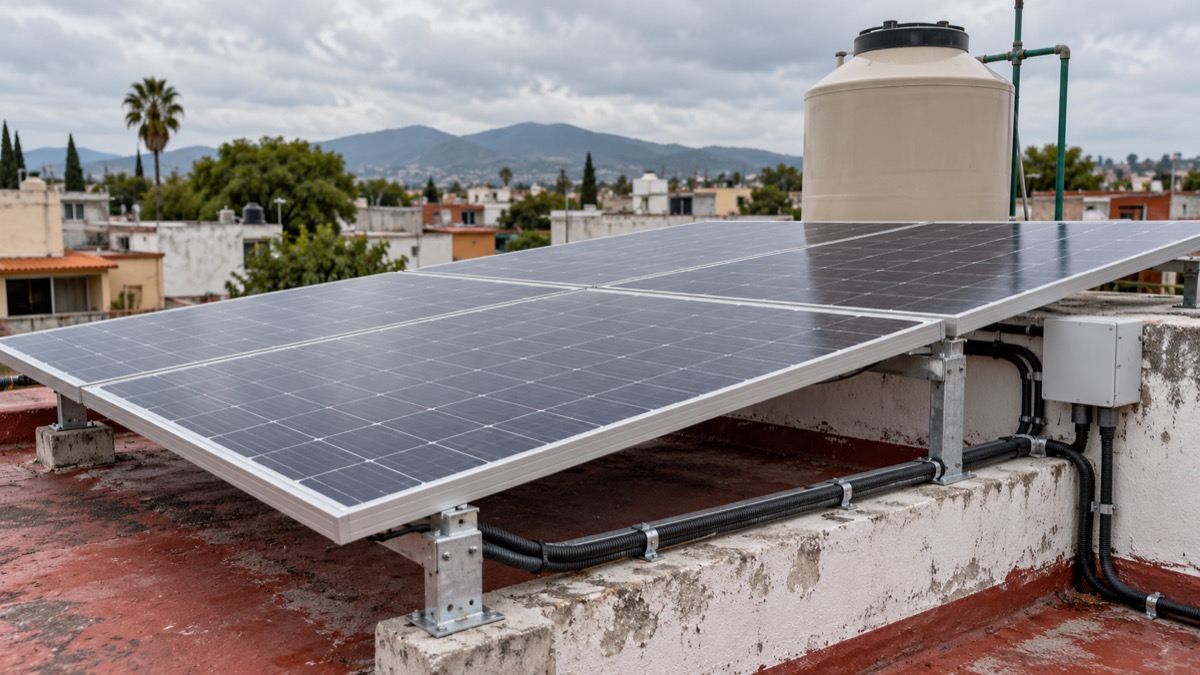
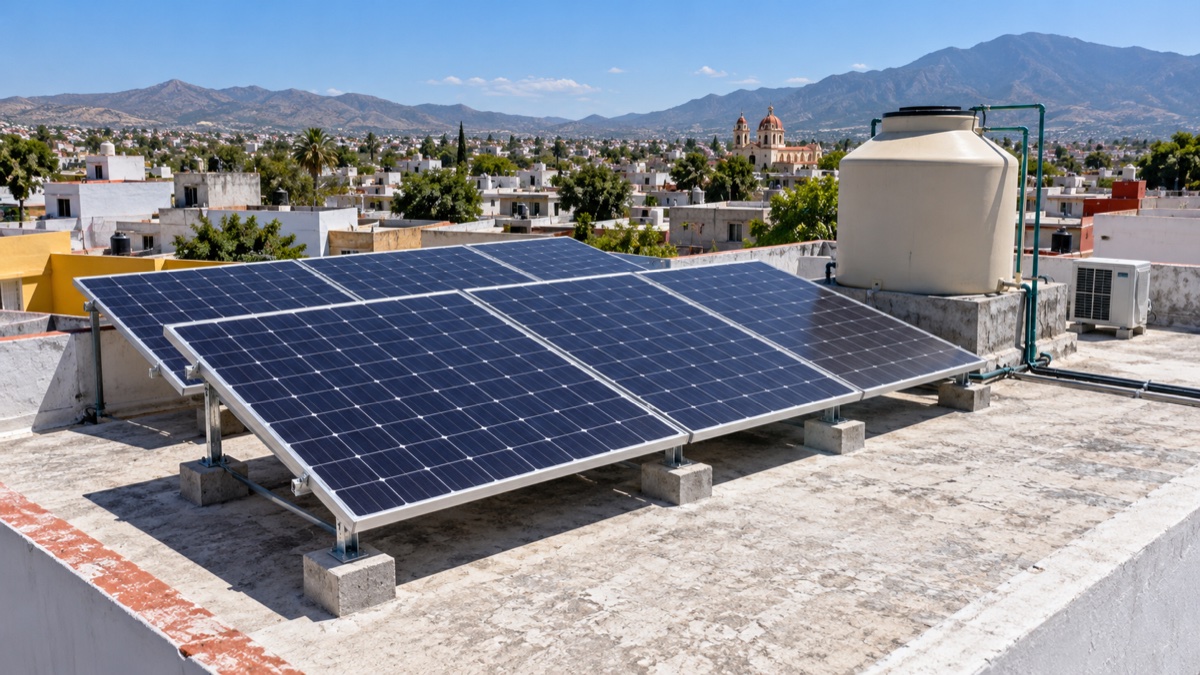
| Panels | They turn light into direct current electricity, which your appliances can't use. |
| Structure | It holds the panels to the roof at the chosen angle and orientation. It must withstand wind and weight. |
| Inverter | It turns direct current into alternating current, which your appliances and the grid use. It's the brain of the system. |
| Protections | Switches and fuses that cut the current if there's a fault and let you shut off the system. |
| Panel board (tablero) | The point where solar energy enters your electrical system and reaches your appliances. |
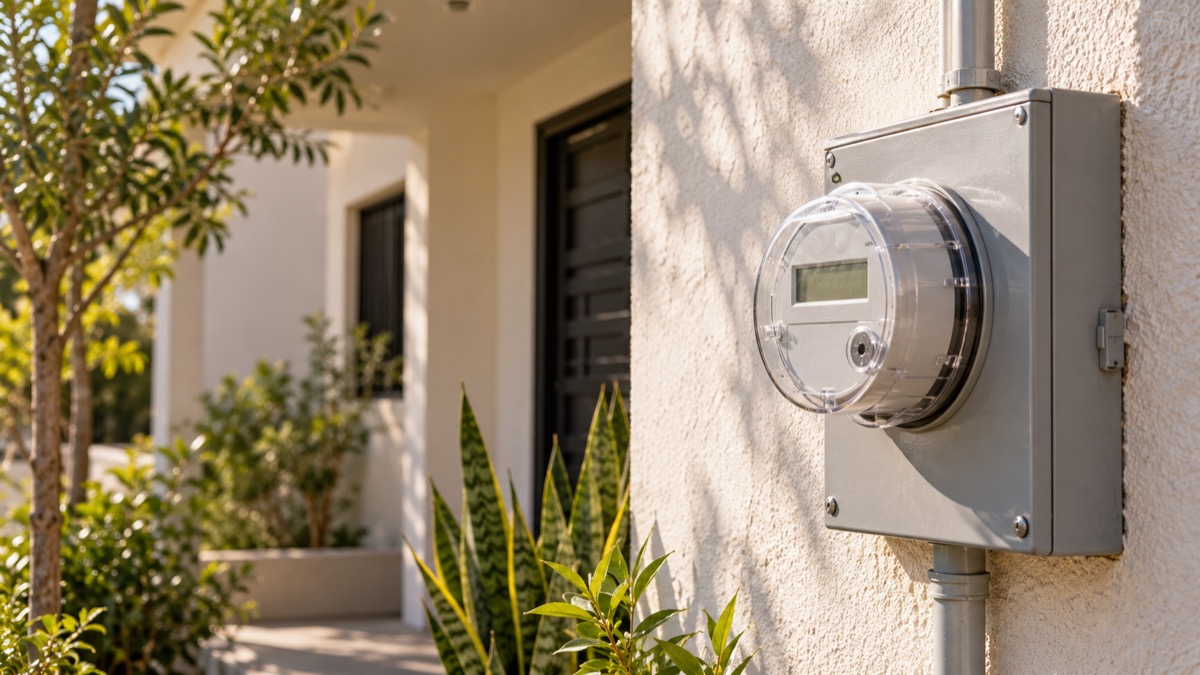
| Bidirectional meter | CFE installs or checks it. It counts separately what you take from the grid and what you send to it. |
| Monitoring | An app or portal, usually from the inverter, for seeing how much you produce. |
The path of the electricity
A normal day looks like this.
- During the day, with sun: the panels produce, the inverter converts, and your appliances use that energy first.
- If you produce more than you use: the surplus goes out through the meter to the grid.
- If you use more than you produce: the grid fills the gap, without you noticing the change.
- At night: there's no production and all your energy comes from the grid.
- At the end of the period: CFE compares what you took with what you delivered, according to your contract's arrangement.
What happens in a blackout
This surprises many people: if the power goes out, a regular grid-tied system shuts off even when the sun is shining. That's on purpose. The rule requires the plant to detect that it's on its own and disconnect within 0.5 seconds, so it won't send current into a grid that should be off, where technicians may be working.
To have power during blackouts you need batteries and an inverter that allows backup. That's a separate cost. If it matters to you, say so when you ask for a quote.
Source: Diario Oficial: Resolution RES/142/2017 on distributed generation, contract templates and compensation (March 7, 2017) ↗The stages and how long each takes
These times are an installer's reference, except for the CFE deadline, which is the official maximum. Treat them as an order of magnitude.
| Stage | What happens | Approximate time |
|---|---|---|
| Usage analysis | They review your bills, ideally 12 months | Immediate, with your bills |
| Preliminary proposal | System size and estimated savings | 2 to 3 business days |
| Technical visit | They check roof, shade, structure and panel board | 3 to 5 days, with the analysis |
| Final proposal and contract | Brands, plan, schedule and warranties | 2 to 3 business days |
| Physical installation | Structure, panels, wiring and inverter | Depends on size (see below) |
| CFE paperwork | Application, letter, contract and meter | 13 to 18 business days as the official maximum; installers report 10 to 30 |
| Switch-on and monitoring | Setup and first readings | Less than 1 day after CFE approval |
How long the work takes by size
One installer's reference for businesses is this. A home usually has few kWp, so it normally falls at the low end of the first range.
| System size | Installation time |
|---|---|
| Up to 50 kWp | 3 to 7 days |
| 50 to 200 kWp | 1 to 3 weeks |
| Over 200 kWp | 3 to 6 weeks or more |
What happens on installation days
This is the normal order of the work. Ask questions: a good installer explains each step.
- They inspect the roof and mark where each part goes.
- They fix the structure and seal the penetrations to prevent leaks.
- They mount the panels and connect them to each other.
- They place the inverter somewhere ventilated and shaded.
- They install protections and conduit, and connect to your panel board. There may be a short power cut here: ask them to warn you first.
- They test that everything works and set up the monitoring.
- They hand over the diagram, the warranties and an explanation of how to shut off the system.
What can delay it
These are the most common delays, and almost all of them can be prevented.
- Incomplete documents, or a bill with a past-due balance or in someone else's name.
- A roof that first needs waterproofing or reinforcement.
- An old panel board or a service entrance that has to be replaced.
- No capacity on your CFE circuit, which forces a study or work.
- The workload at your CFE office.
- Equipment that isn't in stock when you sign.
What to ask before you sign
Ask for the answers in writing.
- What's the schedule, with start and delivery dates?
- Who handles the CFE paperwork, and is it included in the price?
- Is there a warranty on the panels, the inverter and the labor? How long does each last?
- Who is responsible if the installation causes leaks?
- How will I see what it produces, and who provides service if it fails?
- What happens if CFE asks for work or takes longer than expected?
After the installation
The CFE contract obliges you to maintain the system according to the manufacturer's manuals. That normally means cleaning the panels when they gather dust and checking connections and production.
Check the monitoring every month. A big drop with no explanation, such as a cloudy season, usually points to dirt, new shade or a fault. When you get your first bill, compare the energy delivered and received against what the app shows.
Source: Diario Oficial: Resolution RES/142/2017 on distributed generation, contract templates and compensation (March 7, 2017) ↗Sources and scope
The numerical examples are hypothetical. Tariffs and conditions can change and depend on the service; check your bill and current sources before making a decision.
- Diario Oficial: Resolution RES/142/2017 on distributed generation, contract templates and compensation (March 7, 2017) ↗
- Niko (installer): stages and timing of a business installation; commercial reference, not an official timeframe ↗
- Diario Oficial: Interconnection Manual for Generation Plants under 0.5 MW (December 15, 2016) ↗
- ContrataBien: interconnection step by step; reported timeframes, not official ↗